
People you can test things on
Verbll is a human simulation platform. Each simulated person has their own personality, emotions, memory and goals. You place them in a real place or a web app and read how every one reacts.
Find the risk before it finds you.
Verbll is a human simulation platform: realistic people, each with their own personality, emotions and memory. Their minds run on algorithms, not a language model, so every reaction comes with a reason.
The film
Verbll is a human simulation platform. Each simulated person has their own personality, emotions, memory and goals. You place them in a real place or a web app and read how every one reacts.
A common approach is to prompt a language model to play a person. Verbll's people run on algorithms for memory, emotion and decisions. The core has no language model. We also build the mind differently, as the next sections show.
Change one thing, run again, and read a reason for each reaction. A mistake in a simulation costs nothing. A mistake in the real world costs people and money.
A milestone for us
Our first memory test: one photograph, stored in a single pass. The first attempt came back as a coarse, blocky scene. After several rounds of tuning the memory's plasticity and recall, it came back sharp. We are proud of this one.
Usually needs repeated exposure and rehearsal to hold a detailed scene. What they recall is a reconstruction, never a copy.
Learns a scene the first time it sees it, and recalls it sharp. Its memory is built to get better with use.


 Waiting for the result
The Superbrain
Every simulated person runs on a Superbrain: memory, attention, emotion and decisions, all as algorithms. This is what sets it apart.
Inspired by neuroscience.
Training, done differently
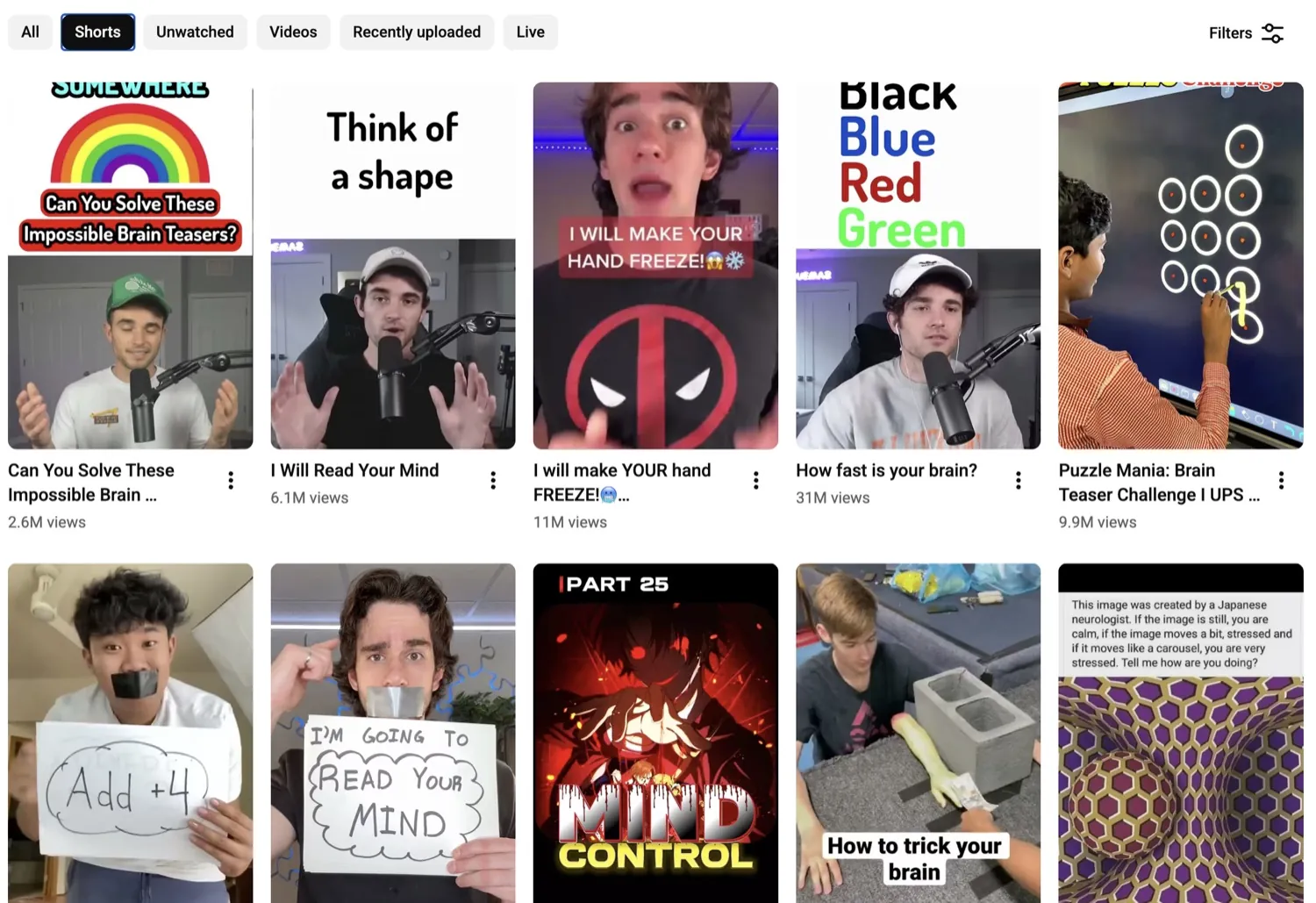
The usual route trains a model on data. We study what people already do to improve their own minds, try it on ourselves, and build what works into the Superbrain.
Gather datasets. Clean them. Train models. Try to recreate the brain.
Learn from what people already do to improve their own minds. Try it on ourselves. Build what works into the algorithm.
Tutorials, memory tricks, brain teasers, illusions and mind-reading puzzles. Short videos like these draw millions of views each.
We run each method on ourselves first, and keep the ones that work.
Each method that works becomes a step in the Superbrain's algorithm flow.
 Watch
The simulated world
A situation can be an argument, a storm, a compliment or a lost job. Verbll turns it into a few numbers, and the Superbrain's emotion engine responds. Watch a situation push the emotions up and down.
Emotion does not sit beside thought. It steers it. The emotion engine feeds the Superbrain's attention, memory, risk appetite and voice, so every answer a simulated person generates is coloured by what they feel at that moment.
Counts from the Verbll situation library.
A friend group drifted apart after a quarrel, about 22 years ago. Lesson kept: quarrels need repair fast.
10,000 people
Each one is a full profile, grounded in real-world statistics we researched. A person is not an average. They have contradictions, blind spots and formative memories, so they react the way that particular person would.
A reaction depends on who a person is, what happened to them and how they cope, not on one average profile. The card on the left is one of the 10,000.
Physics in the simulated world
The world around each simulated person obeys physical boundaries. Walls, desks and pillars are solid, people keep their distance, and every person is heading somewhere. Physics is what turns a crowd of dots into a crowd that behaves.
Maps to 3D
Choose any real place and a radius. Verbll takes the real streets, blocks and buildings, builds them in 3D and fills them with people. You test the place before anything is built, closed or opened.
Computer use
Simulated people use a real browser: they look at the page, move the mouse, click and type at human pace. Use it to test web apps or to automate your own repeated work.
Use cases
Select a card to read more.
Simulate citizens of every income, age and level of trust in institutions. Watch who complies, who objects, who is left out, and why, before the policy reaches a single real person.
You read: reactions by group, with a reason for each.
The AI revolution is changing the job market. Simulate a student on each path and explore how skills, stress and choices play out as work changes around them.
You read: how each path could unfold, with the stress and choices along the way.
Build the venue and its streets in 3D. Place the barriers, the gates and the police posts. Send in the crowd and watch entry, exit and waiting time.
You read: queues, bottlenecks and the safest layout.
Teach an agent a repeated task on your own computer, once. It repeats the task in a real browser and runs on a schedule you set.
You get: hours back, and a log of every run.
Many different people try your app. Some stay. Some leave. Each one tells you what confused them and whether they would use it.
You read: where they got stuck, and the honest view of each.
Rebuild a situation with the place and the people. Change one fact and run it again. Useful for lawyers and investigators working out how people could have reacted.
You get: the scene replayed with one fact changed, and how each person responds.
Why Verbll
“We failed many startups, and every time the problem was the same. We had never checked whether anyone wanted the idea. So we tried interviews, but getting to the right people took so long that the time was gone before the answers came. Then we moved to AI agents and let different models brainstorm for us. It still did not work, because those agents say the same things over and over. They were trained once and then frozen, so there is nothing new inside them, and web search does not fix that. We needed something that could use the latest information and treat a problem like a real person would. So we asked why not place people that behave like real humans inside a computer simulation, and that is how Verbll was born. It runs a simulation as close to the real world as possible, so nobody gets hurt and nobody pays for a bad loan or a bad launch. Most simulations today use frozen AI agents. Run one again and you get the same result in slightly new words. Nothing changes and nothing grows. That is what we are solving. Every person in Verbll has their own brain, and it keeps learning as you keep running.”
Built for people like you
Verbll was not made for a market. It was made for the person who has a decision to make and no safe place to try it first.
It is 1 a.m. and you are rewriting the pricing page again. You have no time to interview fifty strangers and no budget to be wrong. Verbll gives you fifty strangers before breakfast, and every one of them tells you why they would stay or leave.
You sign off on a plan that thousands of people will live inside, and the only test you get is the day it opens. Verbll walks the crowd through it first, so the problem shows up on your screen and not in tomorrow's headlines.
You have a theory about why people do what they do, and a study that takes eighteen months. Change one fact in Verbll, run it again before lunch, and see which people break first.
You are twenty-two, everyone has advice, and nobody knows what work will look like in five years. Walk each path in a safe world first and feel where it gets hard, before you commit a year of your life.
Launching 2027
Verbll launches in 2027. Join now to be first in line, and tell us what you would simulate.